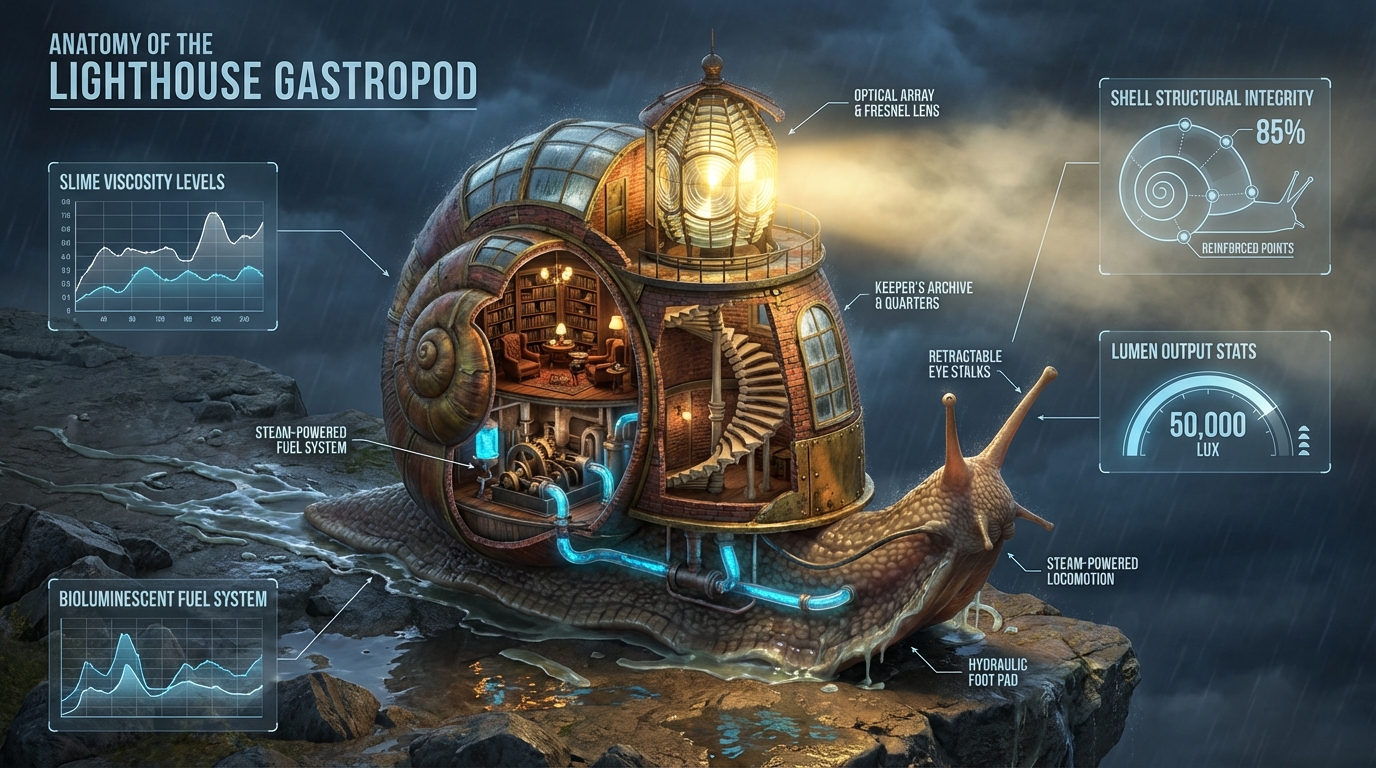
Blueprint of the Sentinel Gastropod
A hyper-realistic isometric cutaway reveals the intricate bio-mechanical interior of a colossal snail carrying a functioning Victorian lighthouse shell through a stormy night. This fusion of vintage anatomy illustration and sci-fi data visualization highlights a glowing steam-powered engine, a vertebrae staircase, and a massive Fresnel lens cutting through the fog.
Generation Prompt
A hyper-realistic, 8k isometric cutaway infographic titled "ANATOMY OF THE LIGHTHOUSE GASTROPOD." The subject is a colossal, bio-mechanical snail moving slowly across a jagged, rainy cliffside. The snail's shell is a fully functioning, multi-story Victorian lighthouse composed of weathered brass, red brick, and spiraling glass windows. The image features a clean surgical cross-section of the shell, revealing the interior architecture: a spiral staircase made of vertebrae, a steam-powered engine room pumping glowing blue bioluminescent fuel, a tiny cozy keeper's library filled with miniature books, and a massive Fresnel lens at the top emitting a piercing beam of warm yellow light cutting through heavy fog. Floating holographic data visualizations surround the creature, displaying "Slime Viscosity Levels," "Shell Structural Integrity," and "Lumen Output Stats" in sleek, white sans-serif typography. The lighting is a dramatic mix of moody atmospheric storm blues and the warm, inviting glow of the lighthouse lamp. The texture quality is extreme, capturing the slime glistens on the snail’s skin, the rust on the iron railings, and the condensation on the glass. The style is a fusion of a vintage biological textbook illustration and a high-tech sci-fi blueprint.