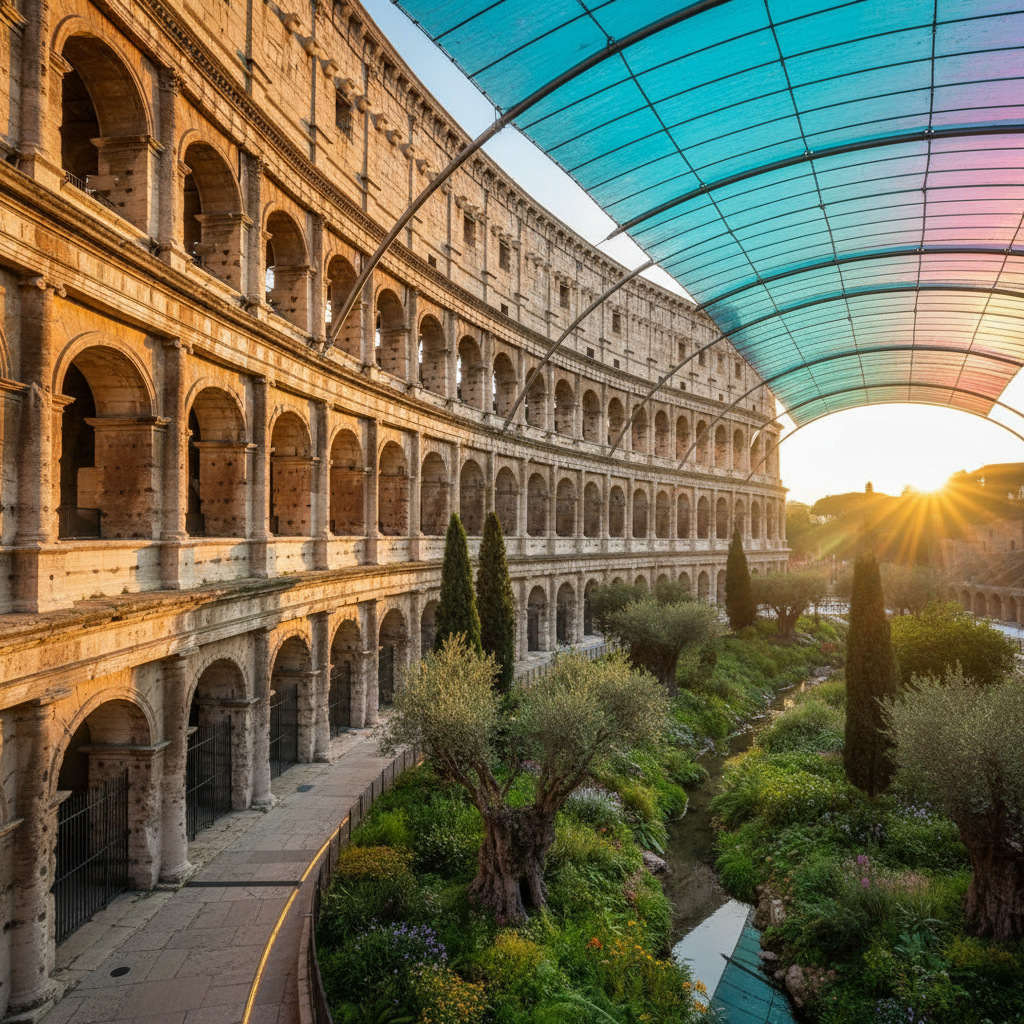
Under the late golden hour's embrace, the Colosseum's ancient stones meet a luminous future. An iridescent canopy shelters a thriving arboretum, weaving together millennia of history and ecological rebirth.
An ultra-photorealistic, gallery-quality photograph of the Roman Colosseum in the year 2100, viewed from a low-angle perspective on one of the upper tiers during the late golden hour. The ancient, weathered travertine stone of the Colosseum's structure glows with a warm, honey-toned light, its pockmarked and time-worn texture rendered in incredibly sharp detail. Lichen and resilient moss cling to crevices, their deep greens a stark contrast to the golden stone. Interwoven with the original structure is a breathtaking, minimalist architectural intervention: a semi-transparent, self-healing polymer canopy stretches across sections of the open roof, its surface subtly iridescent like a dragonfly's wing. This canopy is supported by impossibly thin, carbon-fiber arches that follow the original lines of the building, reflecting the setting sun with a soft, metallic sheen. The arena floor below has been transformed into a lush, sunken arboretum. A meticulously managed ecosystem thrives where gladiators once fought, featuring ancient olive trees with gnarled trunks, clusters of tall, slender Italian cypress trees, and a vibrant undergrowth of native wildflowers and ferns. A narrow, crystal-clear stream meanders through the greenery, its surface reflecting the sky and the intricate structure above. The lighting is the hero of the image. The low sun, just out of frame, casts long, dramatic shadows that carve through the architecture, creating a powerful interplay of light and dark. Rays of golden light pierce through the arches and the semi-translucent canopy, creating visible, cinematic beams in the slightly misty air. The canopy itself filters the light, casting soft, shifting patterns of cyan and magenta onto the foliage below. Subtle, warm LED guide lights, embedded seamlessly into the modern pathways, have just begun to activate, tracing the curves of the tiers. The composition is a wide-angle shot, capturing the immense scale and the juxtaposition of old and new. The camera is positioned looking across the arena towards the far wall, with the sweeping curves of the seating tiers creating strong leading lines that draw the eye into the scene. Through a massive archway in the background, a glimpse of a cleaner, greener 2100 Rome is visible—sleek, white buildings with vertical gardens, and the silent, graceful arc of a distant maglev transport against a clear, violet-hued twilight sky. The atmosphere is one of profound serenity and contemplative awe—a monument not to brutal spectacle, but to history, nature, and sustainable preservation. As a dynamic element, a fine mist from an atmospheric climate system hangs in the air, catching the light, while a lone caretaker in a simple, functional jumpsuit is seen walking on a pathway in the distant arboretum, providing a sense of human scale.